


The State of US Vaccine Policy
A federal-state split, conflicts of interest, and a wave of bills targeting childhood vaccines
This past month, my kids’ small-town school has been in crisis mode. Budget shortfalls, emergency meetings, parents scrambling to understand policies and funding formulas we’d never had to think about before. A lot of us showed up not really knowing the ins and outs, but once we learned what was happening, we got involved. We spoke up. We figured out how to help (or at least we’re trying to).
I keep thinking about that experience as I watch what’s unfolding with vaccine policy across the country. There’s so much happening right now, at the federal level, in statehouses, in courtrooms, that even I find it hard to track, and I live and breathe public health and health policy. Who can blame anyone for feeling lost?
That’s why we’re launching this new series in collaboration with CIDRAP, the Center for Infectious Disease Research and Policy at the University of Minnesota. Our goal is to help you make sense of what’s happening, where it’s happening, and why it matters, so that if you want to get involved, you can. Consider this your catch-up guide. It’s also available as a PDF here.
-Jess Steier, DrPH, Unbiased Science Founder & CEO
The Schedule Overhaul (and the Response)
If you’ve been trying to follow along but feel like you’re missing pieces, you’re not alone. Let’s discuss…
On January 5th, following a presidential directive, the Acting CDC Director signed a memorandum cutting the number of universally recommended childhood vaccines from 17 diseases to 11. (It had been 18 until HHS removed the COVID-19 vaccine from the schedule last fall.) This bypassed the Advisory Committee on Immunization Practices (ACIP), the expert panel that traditionally makes these recommendations through public meetings with scientific review and votes.
Six vaccines were reclassified. Some that used to be recommended for all children are now recommended only for high-risk groups. Others were moved to “shared clinical decision-making.“ The term sounds empowering, but in medicine, it signals something specific: that no clear recommendation exists for everyone. Polls from the Annenberg Public Policy Center found that most Americans don’t understand what the term means — and a quarter mistakenly think it refers to discussing vaccines with family members. Parents have always been the decision-makers for their children’s health care. This label doesn’t give them more options; it just adds confusion.
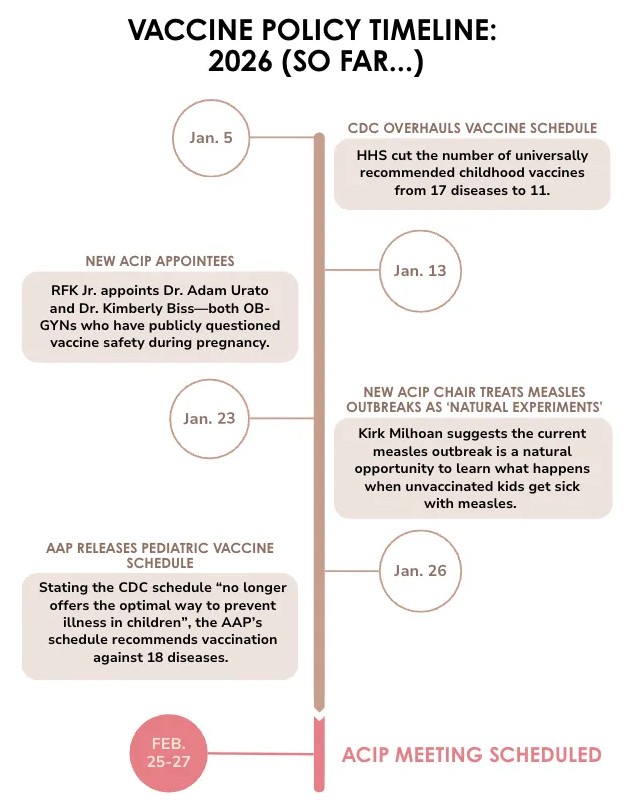
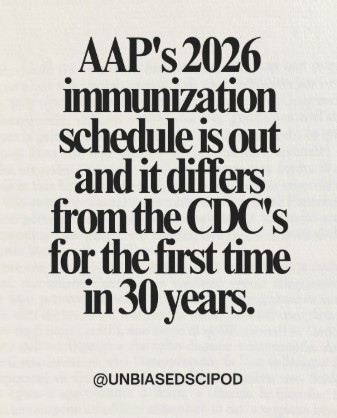
The AAP responded on January 26th by releasing its own 2026 schedule recommending vaccines against 18 diseases (including COVID-19). Twelve major medical organizations endorsed it. The AAP didn’t mince words, saying the CDC schedule “no longer offers the optimal way to prevent illnesses in children.”
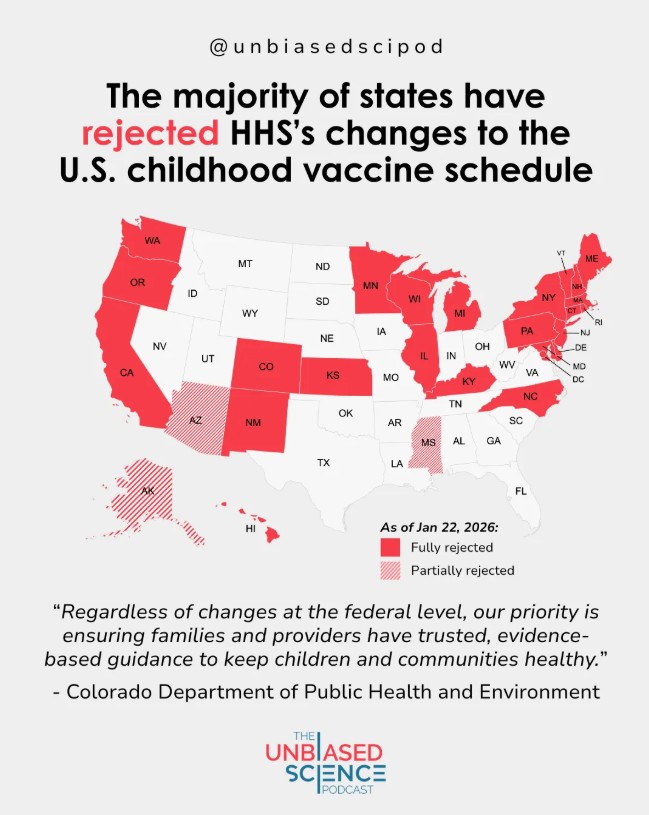
In an unprecedented move, a group of 15 Democratic governors—and ultimately the majority of U.S. states—have formally adopted the AAP’s recommended vaccine schedule. Pediatricians nationwide continue to follow the AAP’s guidance, which remains the professional standard of care.
For the first time, the medical establishment and the federal government are publicly split on how to protect kids from preventable diseases. Parents are now navigating conflicting guidance from their pediatrician and their government.
On January 13, Kennedy appointed two new members to ACIP: Dr. Adam Urato and Dr. Kimberly Biss, both obstetrician-gynecologists. They join 11 other members selected by Kennedy after he fired the previous panel last June. Urato has questioned the safety of vaccines during pregnancy, contradicting evidence-based recommendations. Biss testified before Congress in 2023 that miscarriage rates at her practice rose after COVID-19 vaccines became available, lacking any evidence to back her claim. Former ACIP member Paul Offit called her testimony “outrageous.”
And then there’s the new Kennedy-appointed ACIP chair, Kirk Milhoan. In interviews last week, he said the committee is “reevaluating all of the vaccine products.” He suggested the current measles outbreak is an opportunity to observe what happens when unvaccinated people get sick. The person chairing our national vaccine advisory committee is describing a disease outbreak as a natural (and frankly, unethical and dangerous) experiment on American children.
These are the people advising the federal government on which vaccines American children should get. Though it’s worth noting that when Kennedy overhauled the childhood vaccine schedule on January 5, he did so without consulting them. He bypassed ACIP entirely, which raises questions about the committee’s actual role in setting policy and whether established processes are being followed at all.
AAP v. Kennedy is an active lawsuit filed last summer by the American Academy of Pediatrics and other medical organizations. The defendants (AAP) are arguing that the administration overstepped its authority when it unilaterally rewrote vaccine recommendations and replaced the scientific experts on ACIP. In January, a federal judge denied the government’s attempt to get the case thrown out, which means it moves forward. The judge referenced a brief from public health law experts in his decision, which is a good sign that courts are taking this seriously.
Kennedy’s conflicts of interest keep piling up. Senators Warren, Markey, Blumenthal, and Alsobrooks sent Kennedy a letter this week about his ties to Wisner Baum, the law firm suing Merck over the HPV vaccine Gardasil. It’s important to note that Kennedy had been referring vaccine injury cases to the firm since at least 2018 and was entitled to a 10% cut of any successful judgments. After pushback, he signed that financial stake over to his son, who works at the same firm. Meanwhile, Kennedy has refused to recuse himself from HHS decisions involving the vaccine. And multiple Kennedy allies who are now shaping vaccine injury policy had active cases pending before the very program they’re redesigning.
Bottom line: The person making national vaccine policy has financial connections to people who profit when vaccine injury claims succeed. The senators called it “a dangerous backdoor overhaul of the vaccine courts that is hidden from public scrutiny.”
The vaccine injury system itself is being taken apart. This one needs some context—and to understand where we’re headed, we need to look back at how we got here. Back in 1986, Congress created the Vaccine Injury Compensation Program (VICP) to handle the rare cases of vaccine injury through a streamlined federal process. It keeps cases out of civil court, giving families a faster path to compensation while ensuring manufacturers aren’t sued out of the market. The program uses something called a “vaccine injury table,” which determines what conditions qualify for compensation. An advisory panel provides required input before changes can be made to that table.
Kennedy, a longtime promoter of debunked vaccine-autism claims, has fired at least half of the panel’s members. If he fills it with allies, it opens the door to adding conditions like autism to the table, despite no scientific evidence connecting vaccines to autism. Experts warn that it could bankrupt the program’s $4 billion reserve, push cases into civil court, and ultimately threaten the vaccine supply, all while financially benefiting the attorneys in Kennedy’s circle.
The advisory panel met just once in all of 2025, cramming four required quarterly meetings into a single day in late December. It was the group’s first meeting since July 2024, and there are currently no meetings scheduled for 2026. So, the safeguards that were built into this system are being quietly removed before any changes are even proposed. That should concern everyone, regardless of where they fall on vaccines.
This is where it gets personal for many families, because it’s the states that actually set vaccine requirements for school entry, where our children spend 8 hours a day, 5 days a week. The federal schedule is a recommendation. So the federal changes gave anti-vaccine groups a powerful new argument. If the federal government no longer recommends these vaccines for all kids, why should your state require them?
A new Stateline analysis of federal data found that at least 33 states are now below herd immunity thresholds (the level of vaccination needed to protect those who can’t be vaccinated) for kindergartners, up from 28 before the pandemic.
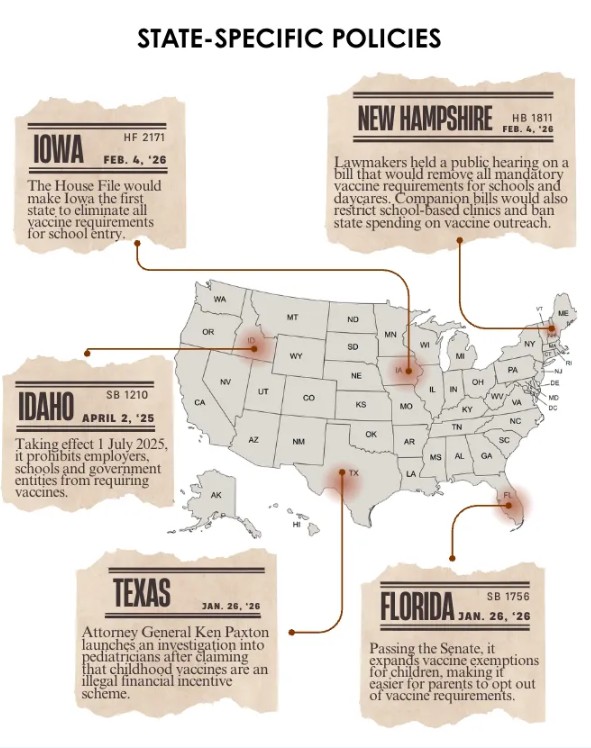
In Texas, Attorney General (AG) Ken Paxton launched an investigation into pediatricians who vaccinate children, claiming they are part of an illegal financial incentive scheme. He’s issuing civil investigative demands to entities, including UnitedHealthcare and Pfizer. This is the same state where two unvaccinated children died during last year’s measles outbreak and where Dallas County’s kindergarten vaccination coverage dropped from 94% to 89% in a single year. The state’s AG is going after the doctors trying to protect kids. For the record, pediatricians don’t get rich from vaccines — many actually lose money administering them. (We dug into the economics in a recent investigation.)
In Florida, a bill to expand vaccine exemptions narrowly passed committee this week. It keeps MMR, DTaP, and polio vaccine requirements but adds “conscience” as a reason to opt out. Two Republicans actually voted against it. Senator Gayle Harrell said her doctor told her, “I don’t want to go back to medical school to learn how to treat polio.” Separately, the health department is moving to drop requirements for chickenpox, hepatitis B, Hib, and pneumococcal vaccines through rulemaking. Three measles cases have already been reported in the state this year.
New Hampshire held a public hearing yesterday on a bill that would completely end mandatory vaccinations for school and daycare, with companion bills to restrict school-based clinics and ban state spending on vaccine outreach. The bill now heads to an executive session on February 11th. Not everything happening in state legislatures is making national headlines — which is part of why this series exists.
Idaho already banned schools from enforcing vaccine requirements, though the requirements technically remain on the books. It has the lowest kindergarten vaccination rate in the country at about 80%. Iowa may not be far behind. Yesterday, House lawmakers advanced a bill that would remove vaccine requirements for school entry entirely, making Iowa the first state to eliminate them from law.
Mississippi and West Virginia were once the national leaders in kindergarten vaccination, both at 99% before the pandemic. Both now allow religious exemptions — Mississippi by court order, West Virginia by executive action — and both are sliding. Mississippi is seeing its worst whooping cough numbers in a decade, including the state’s first pertussis death in 13 years.
The Medical Freedom Act Coalition, which includes Kennedy’s Children’s Health Defense (the anti-vaccine organization Kennedy founded), is working with lawmakers in nearly a dozen states and plans to expand to all 50. At the December ACIP meeting, committee member Retsef Levi asked anti-vaccine lawyer Aaron Siri how they could help eliminate vaccine mandates. Siri’s answer: it would have to happen at the state level. That playbook is now being executed.
All of this is happening while measles cases are surging (588 already this year), flu season is severe (at least 52 pediatric deaths), and three children have died from measles in the past year.
I know the volume of news is overwhelming. But these aren’t isolated stories. The schedule overhaul, the conflicts of interest, the vaccine court dismantling, the state legislation, and the investigations targeting pediatricians. It’s a lot.
But medical organizations are holding the line. Courts are taking challenges seriously. Some state legislators, including Republicans, are pushing back. A recent JAMA Pediatrics study found that states that held firm on vaccine requirements actually maintained higher vaccination rates during this period of rising hesitancy. The requirements work.
If you live in one of these states, your voice matters. Contact your state legislators. Show up to hearings. The loudest voices in these rooms right now are the ones trying to tear protections down. They don’t have to be.
We’ll keep tracking this. That’s what this series is for.
Stay Curious,
Unbiased Science
This update is also posted on Unbiased Science’s Substack page.
To receive these updates on the day they’re published, subscribe to CIDRAP’s free Daily News Headlines newsletter.
First Appeared on
Source link






