


This Tiny Prehistoric Predator Could Hear You Whisper, Long Before Dinosaurs Walked the Earth
Thrinaxodon, a small carnivorous predator and cynodont from the Early Triassic period, has long intrigued paleontologists due to its anatomical similarities to modern mammals.Its mix of reptilian and mammalian features made it a likely candidate for studying transitions in key evolutionary traits. But until now, there was no solid biomechanical evidence linking it to the development of mammalian-style hearing.
The new study, conducted by researchers at the University of Chicago and published in the Proceedings of the National Academy of Sciences, revisited earlier hypotheses about how cynodonts processed sound. The team used computed tomography scans and advanced simulation software to test the structure of the animal’s skull and jaw.
Evidence Hidden in the Jaw of a Tiny Predator
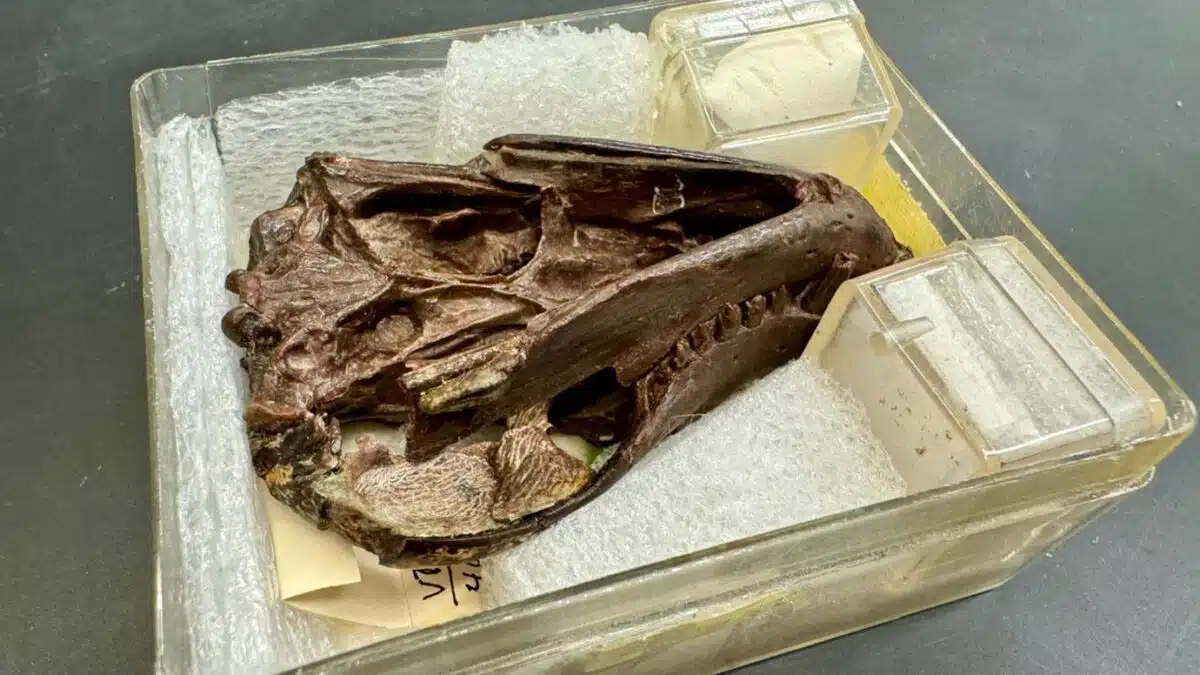
The researchers focused on the skull and jaw of Thrinaxodon, whose fossil remains have been well-preserved since the Early Triassic. According to the research, the team used CT scans to create detailed 3D models of the bones and simulate how they might have vibrated in response to different sound frequencies. The fossil’s unique jaw structure featured a hooked bone formation, which University of Wisconsin anatomist Edgar Allin had speculated in 1975 might have supported a primitive eardrum.
Using software typically applied in engineering fields like aerospace and construction, the researchers assessed how vibrations would have traveled through the animal’s head. Alec Wilken, an evolutionary scientist at the University of Chicago, explained that:
they “took a high-concept problem—how do ear bones wiggle in a 250-million-year-old fossil?—and tested a simple hypothesis using these sophisticated tools.”
A Hearing Range Beyond Bone Conduction
Before the development of a detached middle ear, early animals relied on bone conduction to sense vibrations through their jaws. The predator, however, appears to have had the capacity for tympanic hearing despite having its middle-ear bones: malleus, incus, and stapes, still attached to the jaw. As explained by Wilken’s advisor Zhe-Xi Luo, the 3D simulations showed that:
“That hasn’t been possible before, and this software simulation showed us that vibration through sound is essentially the way this animal could hear.”
The researchers estimate that Thrinaxodon could detect frequencies ranging from 38 to 1,243 hertz, with optimal sensitivity around 1,000 hertz at 28 decibels, roughly the volume of a whisper. While that range is limited compared to humans, who can typically hear from 20 to 20,000 hertz, it would have been a significant improvement over bone conduction and enough for detecting environmental sounds, locating prey, or avoiding predators.
Scientists Confirm a Theory That’s Been Around for Years
For decades, scientists have debated when mammalian hearing truly began. The idea that Thrinaxodon could represent a transitional form has lingered since Allin’s initial proposal over 40 years ago, but technology at the time couldn’t provide confirmation. The new study finally offers physical evidence that supports his early hypothesis.
More than just confirming an old idea, the research alters the broader understanding of mammalian evolution. It reveals that key auditory adaptations, once believed to appear much later, may have begun forming not long after the worst mass extinction in Earth’s history. As Wilken noted, this marks a shift in how paleontologists view the evolutionary trajectory of hearing in early predators:
“For almost a century, scientists have been trying to figure out how these animals could hear… until now we haven’t had very strong biomechanical tests.”
First Appeared on
Source link






