


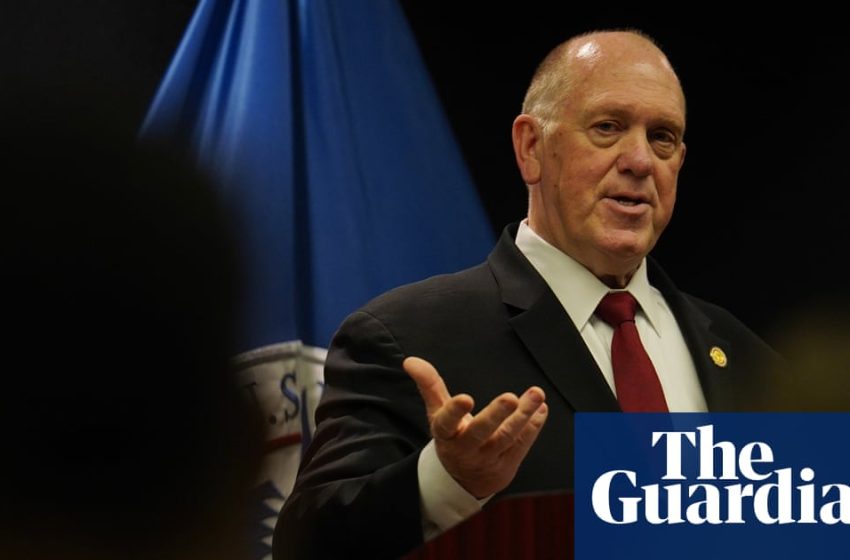
Trump’s border-czar takeover does little to calm Minneapolis tensions: ‘The agenda is still the same’ | Minnesota ICE shootings
In his clearest attempt yet to “de‑escalate” tensions in Minneapolis, Tom Homan, Donald Trump’s “border czar”, announced on Wednesday that the administration will draw down 700 federal immigration officers as the statewide crackdown continues.
The Twin Cities remain on edge, waiting to see whether the fear will ease.
When Homan arrived in Minneapolis more than a week ago, his task was to bridge the widening gulf between local officials and federal law enforcement. Trump dispatched Homan, whom he called “tough but fair”, abruptly, to replace senior border patrol official Gregory Bovino, as the immigration operation in Minnesota spiraled into crisis.
The reshuffle came amid mounting outrage over the fatal shooting of Alex Pretti in late January – the second killing of a US citizen in as many weeks – and a surge of Immigration and Customs Enforcement (ICE) and border patrol officers that has galvanized resistance across the Twin Cities. Trump downplayed the move as “a little bit of a change”, even as he acknowledged Bovino was “a pretty out‑there kind of a guy”.
Homan’s background running ICE – where agents are expected to investigate criminal records and addresses rather than rely on broad street sweeps – could, in theory, lower the temperature. But experts warn that any shift depends entirely on whether he reins in the tactics that have colored the operation so far. “It’s too soon to say if immigration enforcement has dialed back its demographic profiling while targeting immigrants,” said David Bier, director of immigration studies at the Cato Institute, while noting that ICE is “continuing its aggressive and reckless behavior towards protesters and other observers”. Homan told reporters Wednesday that roughly 2,000 federal immigration officers remain in Minnesota — far more than the 150 typically stationed in the state.
Before Homan’s takeover, Bovino’s aggressive raids in parking lots, on streets and in homes – often captured on camera – had drawn widespread backlash. After Pretti’s death, he echoed homeland security secretary Kristi Noem’s baseless claim that Pretti was brandishing a gun and obstructing officers. Noem, now facing calls to resign or be impeached, later said she was relying on “the best information we had at the time”.
Homan, Trump’s foremost immigration policy whisperer, has insisted he didn’t come to Minnesota for “photo ops or headlines”, and has touted what he describes as productive conversations with the state’s governor, Tim Walz; the Minneapolis mayor, Jacob Frey; and the state attorney general, Keith Ellison.
When addressing the press, he has avoided mentioning Renee Good, who was fatally shot in early January, or Pretti by name, but has conceded the enforcement surge hasn’t been “perfect”. He maintained the operation is focused on “public safety threats”, despite multiple cases of people with legal status and no criminal convictions being caught in the dragnet.
One of Homan’s longstanding goals for boosting deportation numbers nationwide is gaining access to local jails. On Wednesday, he said the recent ability to scale back federal immigration officers was due to “unprecedented collaboration” from county sheriffs. According to Homan, some jails have already agreed to notify ICE when they release an undocumented immigrant. Many sheriffs across Minnesota – including those in the state’s largest counties, Hennepin and Ramsey – generally limit working with ICE.
Homan, however, did not elaborate on Wednesday on which counties are now cooperating. Dawanna Witt, the Hennepin county sheriff, did not return the Guardian’s request for comment, nor did Bob Fletcher, the sheriff of Ramsey county.
Minnesota state law says that jails cannot hold someone past their release time so agents can take custody – a practice known as an ICE detainer. “We’re not asking anyone to be an immigration officer. We are not asking any state or local official to do immigration enforcement activity,” Homan said, while insisting that no jail had been asked to keep people “one minute past when they normally would”.
His argument that “more agents in the jail means fewer agents in the street” has drawn significant pushback from immigrant‑rights advocates, who say the offer amounts to coercion and argue that Walz, Frey and Ellison must hold the line.
But Homan is no stranger to this kind of brinkmanship. A taciturn hardliner with decades of experience in immigration enforcement, he served as director of ICE’s enforcement and removal operations under Barack Obama before becoming acting ICE director during Trump’s first term. He helped design some of the administration’s most draconian measures – most notably family separation, a strategy reportedly deemed too severe by officials in the Obama White House, but later central to Trump’s “zero tolerance” policy.
During his tenure leading ICE, Homan frequently argued that any undocumented immigrant was fair game for removal. Before re‑joining the Trump White House, he telegraphed his aims at a national conservatism conference in 2024. “I’ll be on [Trump’s] heels coming back, and I will run the biggest deportation force this country has ever seen,” he said. “They ain’t seen shit yet.”
Homan has consistently lambasted so‑called “sanctuary” policies, claiming that cities unwilling to cooperate with immigration agents are harboring criminals and endangering public safety. “We know that the end game is to try to tell people how to evade law enforcement,” he said at CPAC last year.
In Minneapolis, he underscored that his mass deportation effort hadn’t changed, whether people have criminal convictions or not. “If you’re in the country illegally, if we find you, we will deport you,” he told reporters.
Experts say Homan’s takeover may change the tone, but not the mission. “The goals here are the same,” said Bier. Bovino’s background in border apprehensions, he said, is inherently less targeted and more reliant on profiling. Prior to Homan’s arrival, the federal strategy of “getting in random people’s faces and demanding to see their papers” has only fueled pushback.
Democratic officials in Minnesota have repeatedly said their state is being targeted for reasons unrelated to immigration. If they change their policies now, Bier warned, there’s “nothing stopping” the administration from returning, threatening more raids and demanding more concessions. He also remains unconvinced that violent interactions will subside. “You’re trying to arrest people who, for the most part, are living their life, not causing problems, and have families,” he said.
Javad Khazaeli, an immigration and civil‑rights attorney and former national security prosecutor at ICE, said the biggest difference is stylistic. “Homan is more polished than Bovino. He knows how to talk to the press better, and they realize portions of this operation have blown up in their face because they went on TV and lied repeatedly,” he said.
Khazaeli noted that if local law enforcement begins working with ICE, trust between police and immigrant communities will erode. “The moment you start taking local officers who are not trained in this and making them antagonistic to their community, it hurts public safety. They stop cooperating,” he said.
This week, there have been glimmers of concession from federal officials. Homan announced that the Trump administration will plan to issue body-worn cameras to immigration officers nationwide – a demand from Democrats as they negotiate guardrails as part of a full-year funding bill for the Department of Homeland Security (DHS). Meanwhile, in an interview with NBC News, Trump said that watching the Minnesota crackdown unfold taught him that he might require a “softer touch” when it comes to immigration enforcement. But he continued to repeat misleading claims about the state’s department of prisons, which already works with ICE to facilitate the transfer of people convicted of felonies to federal custody.
For his part, Walz said that while the scaling back of officers in Minnesota is “a step in the right direction”, he needs to see a “faster and larger drawdown of forces” as well as state-led investigations into the killings of Pretti and Good.
On the ground in Minnesota, protesters from the Bishop Whipple federal building to the governor’s mansion say the atmosphere is febrile. Frigid temperatures have proven no match for residents’ anger. Demonstrations persist, mutual‑aid networks grow, observers continue to blow whistles to alert neighbors to immigration agents and clashes with federal law enforcement continue.
“We have no assurances that our neighbors, our students, the families we serve and our relatives are safe,” said Marcia Howard, president of the Minneapolis teachers’ union. “Some people may have breathed a sigh of relief when Bovino was pulled and replaced by Homan, but many educators did not … The agenda is still the same.”
Last week, at one of the near‑nightly vigils at Pretti’s makeshift memorial on Nicollet Avenue, votive candles burned in the cold and carnations held their color against the wind. “We’re still not safe,” an activist told the crowd, as those assembled nodded in agreement.
First Appeared on
Source link






