


Two 7,000-year-old women have DNA unlike anyone else
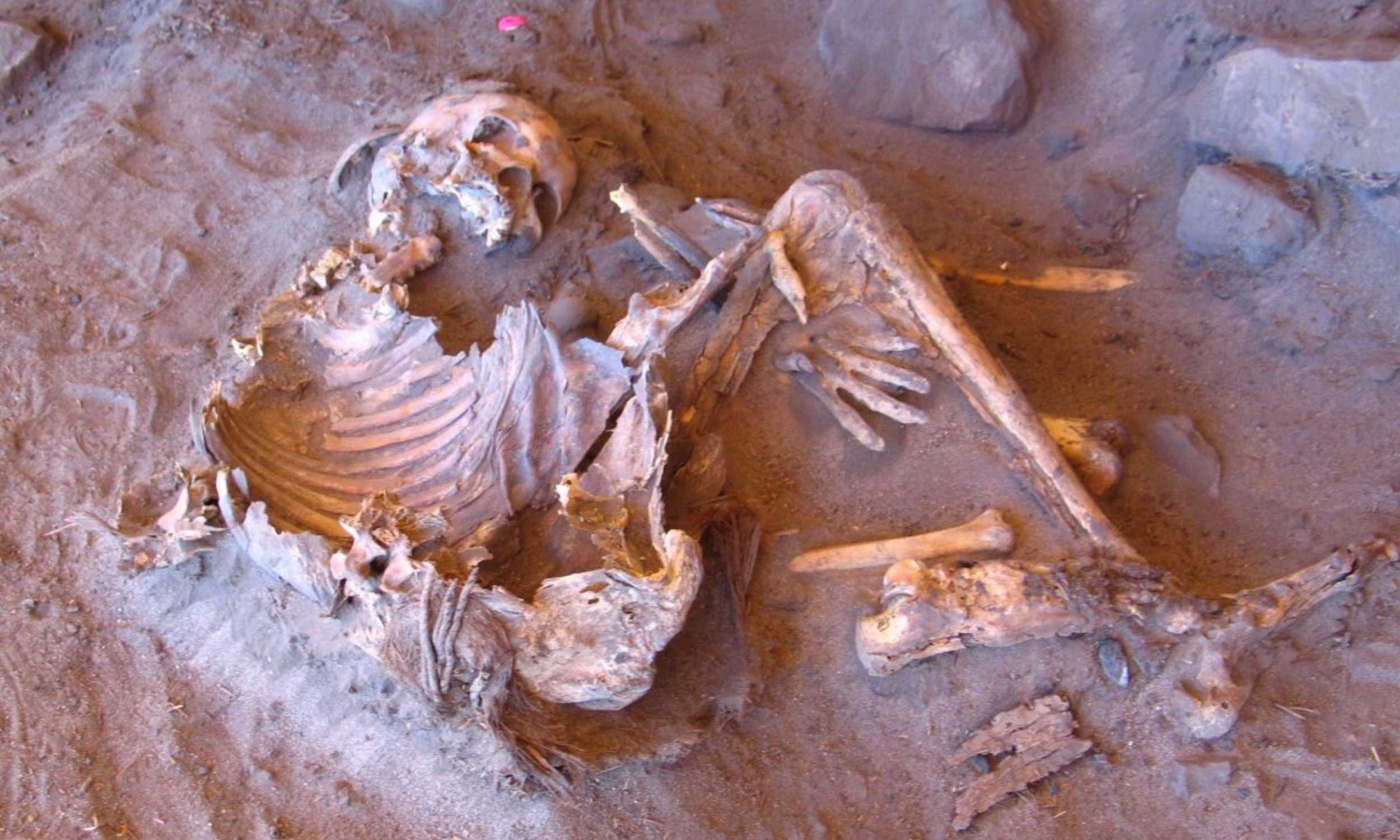
Two naturally mummified women from a rock shelter in southern Libya are pushing scientists to rethink how ancient North Africa was populated.
Genetic tests on the 7,000-year-old remains show that they belonged to a distinct population with no detectable roots in sub-Saharan Africa.
The DNA of the ancient women shows only a tiny trace of Neanderthal ancestry. This small legacy came from an extinct group of ancient humans once spread across Europe and western Asia.
The findings also suggest that herding moved into the central Sahara through shared ideas rather than large migrations.
Together, these clues offer a rare look at people who lived when the Sahara was still green.
Using ancient DNA to track changes
The work was led by Nada Salem, a geneticist at the Max Planck Institute for Evolutionary Anthropology (EVA) in Germany.
Salem’s research focuses on using ancient DNA to track how African populations changed through time.
During the African Humid Period, a long wet phase in North Africa, the Sahara held rivers, lakes, and grassy plains instead of today’s dunes.
Pollen records and climate models show that this wetter state stretched roughly from 14,500 to 5,000 years ago.
As the climate dried again, the once-green Sahara shifted into the vast desert we know now. That change squeezed people and animals into smaller habitable zones along coasts, mountains, and river valleys.
At the Takarkori rock shelter in southwestern Libya, archaeologists uncovered many layers of human activity, from early hunter-fishers to later herders.
Among the burials, they found two naturally dried adult women wrapped in mats, whose bodies were preserved well enough for modern genetic work.
DNA reveals an isolated lineage
A new genetic study sequenced hundreds of thousands of positions in the women’s genomes using teeth and leg bones. The work relied on ultra-clean labs and methods designed to recover short, damaged DNA.
By comparing this ancient DNA with genomes from ancient and modern people, the team placed the Takarkori women on the human family tree and identified ancestry branches that no longer exist in a clear form today.
The results show that most of their ancestry came from a previously unknown North African lineage that split from sub-Saharan Africans around the time other modern humans were leaving Africa about 50,000 years ago.
This branch stayed mostly separate for tens of thousands of years and still appears, in mixed form, across North Africa.
The findings also indicate that this population was local to the central Sahara, matching earlier chemical studies showing that many Takarkori individuals grew up on nearby soils and water.
Morocco’s Stone Age hunters
The Takarkori genomes show a close link to older hunter-gatherers from Taforalt Cave in northern Morocco, who lived about 15,000 years ago.
Those people are associated with stone tools known as the Iberomaurusian tradition, which appears across parts of North Africa.
Taforalt individuals were first described in detail in a landmark ancient DNA paper, which found that they carried a mix of Near Eastern and African ancestry.
That earlier work suggested ties to foragers called Natufians in the Levant, along with an African component that was hard to pinpoint.
By adding the Takarkori genomes, the new work shows that the African component in Taforalt foragers links to the same deep North African branch found in Libya.
The two groups, separated by thousands of years and long distances, are still more closely related to each other than to any other known population.
Why gene flow was limited
Models built from both genomes also show that Takarkori and Taforalt people are equally distant from sub-Saharan Africans.
This suggests that even during the wet, habitable phase of the Sahara, long-term gene flow between northern and southern populations was limited.
Other ancient genomes from the Maghreb show that later farmers from the Levant and southern Europe arrived and mixed with local groups rather than replacing them.
Modern DNA supports this layered history, with a large survey of mitochondrial genomes revealing repeated cycles of contact and isolation across North Africa over the last 10,000 years.
Traces of Neanderthal DNA
The researchers found only about 0.15 percent Neanderthal DNA in the Takarkori genomes.
That amount is about one-tenth of what is common in people whose ancestors lived outside Africa, but still higher than in most ancient and modern sub-Saharan Africans.
The team notes that early North African populations appear to have been mostly isolated but still picked up small traces of Neanderthal DNA through limited contact with groups outside Africa.
This pattern points to rare interactions with communities linked to the Near East rather than steady movement across the Sahara.
The low Neanderthal signal helps place this North African branch close to groups that stayed within Africa, with only faint echoes of encounters that happened elsewhere.
At the same time, the women’s burials and associated tools show a herding lifestyle built around cattle, sheep, and goats, tying this isolated ancestry to early pastoral life in the Sahara.
Herding spread without mass migration
For archaeologists, a major question has been how herding spread into the Green Sahara. Did livestock keepers move in from the Levant, or did local communities adopt new practices as animals and ideas arrived?
According to the researchers, their work challenges earlier ideas about North African population history and points to a deeply rooted, long-isolated genetic lineage in the region.
The team’s models indicate that local communities likely adopted herding practices themselves rather than being replaced by incoming groups.
The analyses suggest that pastoralism likely spread into this region mainly through cultural diffusion, the passing of ideas and practices between neighboring communities.
That conclusion matches archaeological evidence showing both continuity and gradual shifts in tools, pottery, and burial customs at Takarkori.
People of the Green Sahara
Taken together, the archaeological and genetic data show that people in the Green Sahara were active participants in change, not passive recipients of outside influence.
They blended new animals and technologies into older ways of life, shaping cultural traditions that still echo across North Africa today.
By identifying this deeply separated North African branch, the Takarkori genomes help fill a major gap in how scientists understand the Out-of-Africa expansion, a major early migration of modern humans into Eurasia.
The genomes show that an Africa-based sister branch to those migrants persisted in the north of the continent, partly shielded by harsh deserts and complex social boundaries.
The team notes that ancient DNA is essential for reconstructing human history in regions like central northern Africa because it offers evidence that can stand alongside archaeological findings.
The researchers concluded that uncovering the Sahara’s deeper past helps build a clearer picture of human movement, adaptation, and cultural change across this important region.
The study is published in the journal Nature.
Image credit: Archaeological Mission in the Sahara, Sapienza University of Rome.
—–
Like what you read? Subscribe to our newsletter for engaging articles, exclusive content, and the latest updates.
Check us out on EarthSnap, a free app brought to you by Eric Ralls and Earth.com.
—–
First Appeared on
Source link






